
Start with a machine you regularly demonstrate and the floor space where a customer can try it. A cabinet that looks compact against the wall may open into the aisle, and a generous tabletop tells you little about whether the machine bed will sit flush.
Measure the display with the cabinet open
Mark the closed footprint on the floor with tape, then mark the open footprint in a second colour. Pull up a chair, sit at the needle and open the storage. Can another customer still walk past while someone feeds fabric through the machine?
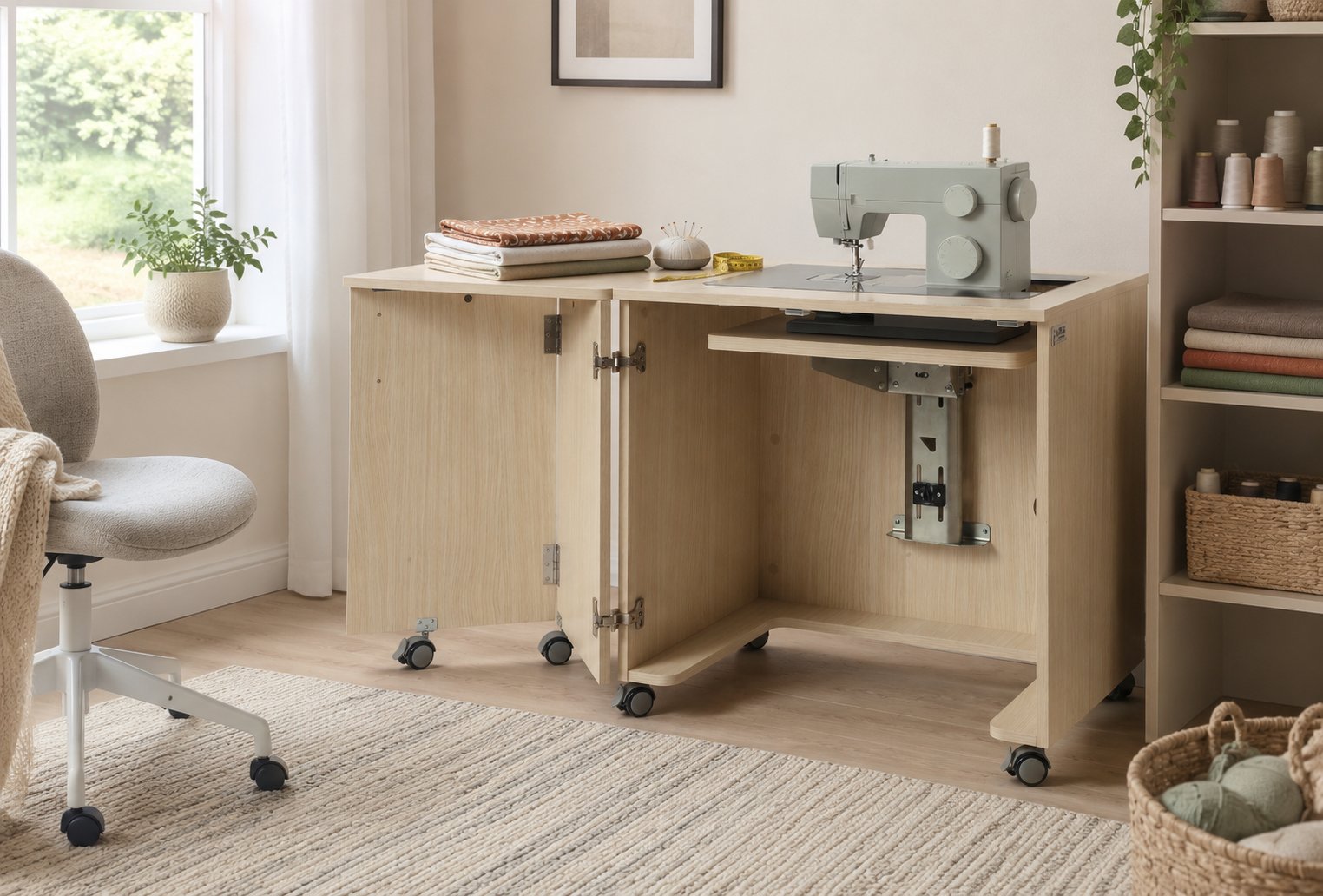
For example, the Luxhome BA-1 measures 750 × 520 mm folded and 1,330 × 520 mm open. Its width increases by 580 mm. The BA-3 goes from 600 × 500 mm to 1,200 × 500 mm. Both are 750 mm high. The BA-3 saves 150 mm of closed width, a useful difference if your display shares a wall with another machine. Compare the folded and open dimensions of all five BA models.
Match the support to the machine you sell
If customers ask for a flat sewing surface for quilting, demonstrate how the machine bed meets the tabletop. The BA-1 and BA-3 have pneumatic lifts. For a shop that demonstrates sergers, the BA-4 cabinet has a pull-out tray. Try the threading sequence, open the looper cover and check where fabric offcuts will fall.
Before quoting a customer, record the machine brand, exact model and weight, then measure the base. Ask Luxhome to confirm the opening, support and any insert required for that model. If you sell an embroidery unit with the machine, include its model and ask how much clearance it needs when attached.
What to include in a dealer inquiry
Send your company name, sales market, the machines you plan to display and the cabinets on your shortlist. If you have an opening order in mind, include quantities by model and your delivery destination so the sales team can discuss pricing and shipping. If you are choosing between two cabinets, tell us the dimension or machine feature that will decide it.